Pastel Protest: How Gen Z Is Using Cuteness as a Tool for Real-World Change
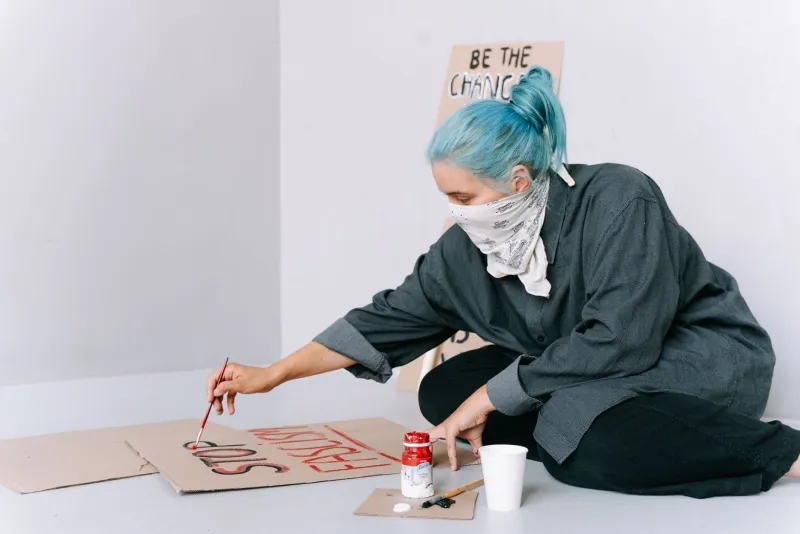
Picture a protest sign. You're probably imagining bold block letters, stark black and white, maybe a raised fist. Now imagine that same message rendered in soft pink and lavender, decorated with tiny stars and a round-cheeked character holding a banner. Same words. Completely different energy.
That second image isn't hypothetical — it's showing up everywhere, from climate marches to mental health awareness campaigns to racial justice organizing. Gen Z has figured out something that traditional activism is still catching up to: cuteness gets people to stop scrolling. And once they've stopped, you've got them.
Why Cute Works as an Entry Point
There's a well-documented phenomenon in communication called the "hostile media effect" — the tendency for people to disengage from messaging that feels confrontational or threatening. Heavy-handed imagery, aggressive framing, and high-intensity emotional appeals can actually cause people to shut down rather than engage, especially on social media where the competition for attention is brutal.
Kawaii aesthetics sidestep this almost entirely. A soft, rounded illustration of a crying Earth or a pastel-colored infographic about mental health statistics doesn't trigger the same defensive response. It's approachable. It's shareable. It ends up in spaces — Pinterest boards, Instagram saves, TikTok for-you pages — where harder-edged content rarely travels.
"The aesthetic does the door-opening," says one digital organizer who runs a climate-focused account with over 200,000 followers. "People engage because it's pretty. Then they read the caption. That's when the actual conversation starts."
Climate Action Gets a Kawaii Makeover
The environmental movement has been one of the earliest adopters of this approach. Accounts like @lil.green.activism (a fictional representative example of a real trend) have built massive followings by presenting climate data through the lens of adorable illustrated characters — melting glaciers with sad eyes, coral reefs rendered in muted pastels to show bleaching, tiny polar bears perched on shrinking ice floes.
The approach has drawn some criticism — is softening climate catastrophe doing a disservice to the urgency of the issue? Creators in this space push back hard on that framing. The argument is that urgency without access is useless. If the content never reaches someone because it felt too heavy to engage with, the urgency didn't matter.
Organizations like the Sunrise Movement have experimented with more playful visual languages in their digital outreach, particularly targeting younger audiences. The shift isn't about minimizing the stakes — it's about meeting people where they actually spend their time and attention.
Mental Health Advocacy and the Healing Power of Soft Graphics
Mental health advocacy might be the space where cute activism has taken its deepest root. The overlap between kawaii aesthetics and mental health communities on platforms like Tumblr, Twitter/X, and TikTok has been building for years — and it's produced a genuinely distinct visual language.
Illustrators and advocates create content that uses soft, round characters to represent experiences like anxiety, depression, ADHD, and burnout in ways that are immediately recognizable to people living with those conditions but gentle enough not to be triggering. The characters cry, they hide under blankets, they struggle with tasks — but they're also huggable. They carry the message that these experiences are valid and survivable.
Creators like Amber Vittoria and a broader wave of mental health illustrators have demonstrated that this kind of work drives genuine community-building. Comments sections fill with people saying "this is exactly what it feels like" — which is exactly the kind of connection that mental health advocacy depends on.
The cute framing also reduces stigma in a very specific way. It's harder to dismiss an experience as weakness when it's being expressed through an adorable little character doing their best. The softness signals that the subject is being approached with compassion rather than judgment.
Racial Justice Through a Pastel Lens
This is where the conversation gets more nuanced — and more interesting. Using cute aesthetics to engage with racial justice causes has been both celebrated and critiqued within activist communities, and the tension is worth taking seriously.
The critique is real: there's a risk that softening the visual language of racial justice strips urgency from issues that are literally matters of life and death. Pastel-ifying a movement can inadvertently center the comfort of audiences who are least affected by the issues at hand.
But creators of color who work in this space make a compelling counter-argument. When Black and brown illustrators use kawaii-adjacent aesthetics to tell their own stories — celebrating cultural identity, depicting joy and community, or visualizing what liberation and safety could look like — that's not softening a message. That's expanding what the movement gets to look like.
Artists like Jamilla Okubo, whose work blends bold pattern-making with joyful, rounded figures, or the broader tradition of Afrofuturist illustration that embraces vibrant, playful aesthetics, are doing work that's both politically engaged and visually celebratory. The cuteness isn't a concession — it's an assertion that joy is also resistance.
The Merch Pipeline: Where Cute Activism Gets Complicated
One of the most effective tools in the cute activist toolkit is also one of the most commercially entangled: merchandise. Enamel pins, tote bags, stickers, and prints featuring activist-adjacent kawaii art have become a significant fundraising mechanism for causes ranging from abortion rights to LGBTQ+ youth support organizations.
The model works well when proceeds go directly to organizations and when creators are transparent about where the money goes. It gets murkier when the line between genuine advocacy and aesthetic-as-brand blurs — when the cute protest imagery becomes primarily a product rather than a message.
Activists in this space talk about staying intentional. The goal is always to use the aesthetic to serve the cause, not to use the cause to sell the aesthetic. That's a line that requires constant attention, especially as cute activism grows more visible and more commercially viable.
What This Moment Is Actually Saying
The rise of cute activism isn't really about aesthetics at its core. It's about a generation that grew up online learning to speak the visual language of the internet fluently — and choosing to use that fluency for something beyond self-expression.
Gen Z didn't invent the idea that art can be political. But they may be the first generation to deploy cuteness so deliberately and strategically as a political tool. The pastel color palette and the round-cheeked characters aren't naive. They're calculated. They're optimized for the platforms where attention lives.
And here's the thing: it's working. Campaigns that lean into kawaii aesthetics are reaching demographics that traditional activist outreach never touched. Young people who might have scrolled past a dense infographic stop for a soft illustration. They save it. They share it. They talk about it.
Cuteness, it turns out, has always had a certain kind of power. Gen Z is just finally using it on purpose.